Latest Blogs

Dashboard Spotlight:
Harnessing the Four Temperaments of Travel Analysis
One of my favorite TV series of the past few years has been Apple TV’s Severance. It’s a sci-fi corporate psychological thriller with a sharp, unsettling exploration of the relationship between work, identity, and control.
The series introduces viewers to Lumon Industries founder Kier Eagan’s doctrine of the “Four Tempers”: Woe, Frolic, Dread, and Malice. Within the story, employees are taught that every human soul is a precise blend of these four emotional components, and that mastering them grants mastery over oneself and one’s environment.
This deliberately absurd corporate philosophy echoes something much older: the Four Humors of Hippocrates and Galen. These classical physicians believed that human health and behavior were governed by four bodily fluids.
Galen later formalized this into four temperaments:
- Sanguine (excess blood to happiness),
- Phlegmatic (excess phlegm to calm),
- Choleric (excess yellow bile to anger)
- Melancholic (excess black bile to sadness).
At Unlocked Data, we have our own four-part framework. But don’t worry, it’s far more human-centered and data-driven than either Lumon Industries or ancient medicine!
We believe that to analyze and communicate effectively, everyone involved, from travel managers, finance teams, sustainability leaders, to travelers themselves, needs to speak the same language, use a shared framework, and align expectations.
When people understand how data is being sliced and why, organizations can book smarter, travel better, and support their people more intentionally.
Our four core components of effective travel analysis are:
- Activity Overview
- KPI Performance
- Sustainability Analysis
- Traveler Intensity.
Activity Overview: The Who, What, When, Where, and Why
Every effective analysis starts with context. Who is travelling, what they are doing, when and where trips take place, and why the travel is happening in the first place. The Activity Overview components of our dashboard establish this baseline. It is intentionally diagnostic and exploratory, designed to answer first-order questions before jumping to judgment or optimization. Without this foundation, travel management risks becoming anecdotal; with it, patterns, concentrations, and inefficiencies become visible.
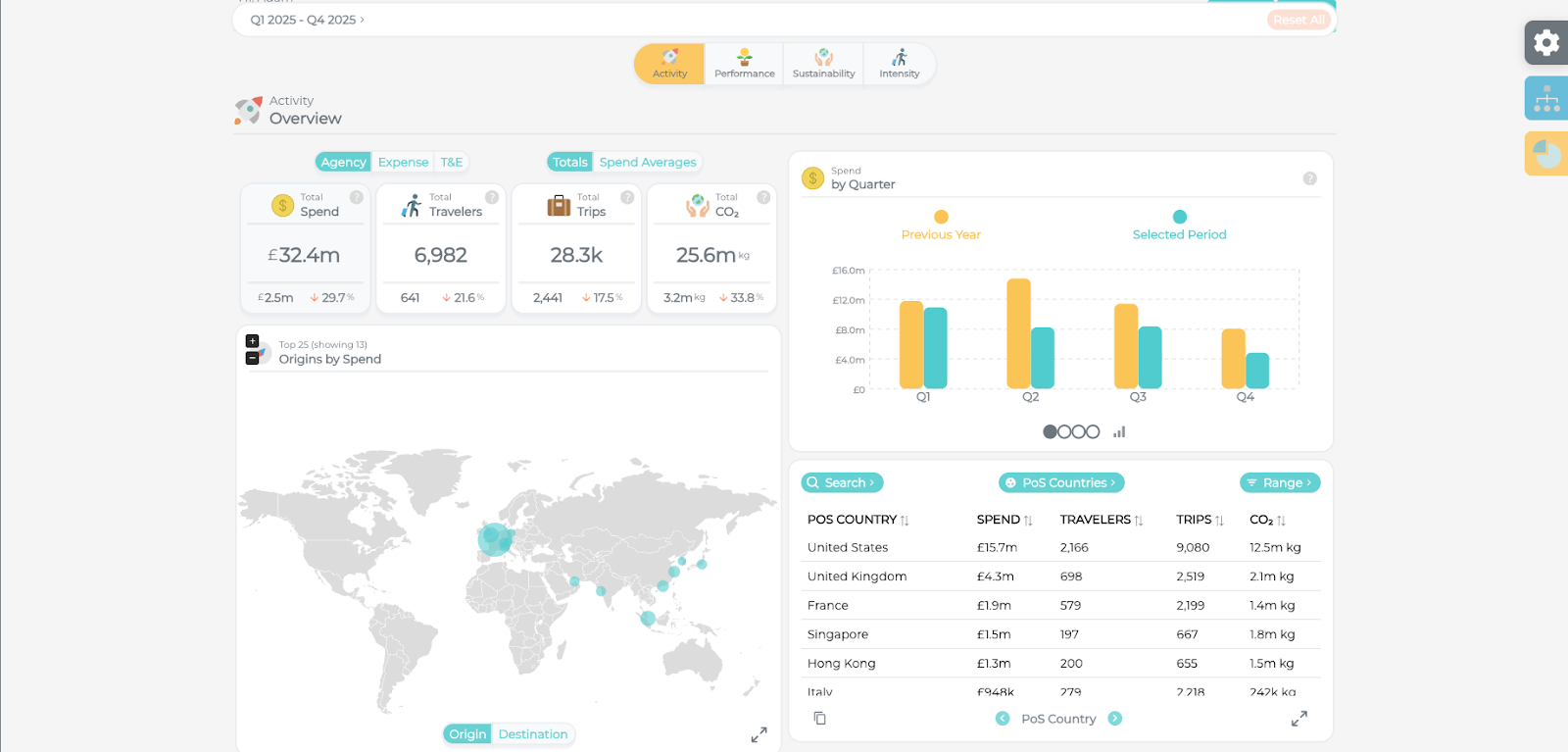
At its core, the Activity Overview captures:
•Traveller details
Organisational attributes such as team, function, or seniority (within privacy and governance constraints), allowing managers to understand who is travelling and how travel is distributed across the organisation.
•Itinerary details
Destinations, travel dates, modes of transport, hotel stays, and trip structure, enabling geographic, temporal, and modal analysis.
•Trip purpose
The reason for travel client meetings, internal collaboration, training, conferences, or other business needs provides essential context when evaluating cost, carbon, or intensity.
•Booking channel and timing
Whether trips were booked through approved tools or outside the programme, and how far in advance bookings were made. This supports later analysis of behavior, compliance, and opportunity.
•Cost summary
High-level financial measures such as total trip spend, average cost per trip, or spend by department. These figures help finance and travel leaders understand where money is flowing before asking whether it is being spent well.
Once this shared baseline exists, deeper questions can be asked with confidence. KPI Performance, Sustainability Analysis, and Traveler Intensity all depend on this layer.
KPI Performance: Compliance and Spend Optimization
Once a clear Activity Overview is established, the next question becomes performance: how well is the travel program behaving relative to its objectives?
The KPI Performance dashboard component is designed to move beyond raw spend and into behavioural alignment. Cost savings still matter, but modern travel programs are increasingly evaluated on how consistently travelers follow policy, how effectively negotiated agreements are used, and where other improvement opportunities exist.

Within the dashboard, KPI Performance focuses on a small number of client-defined, defensible measures, such as:
Policy compliance rate
The share of bookings made within approved budgets, hotel categories, and advance booking windows. Persistent non-compliance often points to unclear policy design or friction in the booking process rather than poor intent.
Booking tool adoption
The proportion of bookings made through approved channels. Strong adoption improves visibility, strengthens supplier leverage, and ensures performance is measured on a complete dataset.
Advance booking behavior
How far in advance trips are booked. Tracking this over time helps distinguish structural constraints from avoidable late booking patterns that drive higher costs.
Savings from negotiated rates
A comparison between available market pricing and contracted rates actually used. This allows finance teams to validate that negotiated agreements are delivering real value, not just theoretical savings.
Average cost per trip
A simple but powerful indicator. Changes here often surface missed discounts, suboptimal booking choices, or shifts in travel mix that warrant investigation.
Our dashboards are intentionally interactive. From any KPI, users can drill into teams, regions, suppliers, channels, or traveler segments to quickly isolate performance gaps. Scenario modeling tools then estimate the order-of-magnitude opportunity associated with incremental
improvement, helping managers prioritize effort where it will matter most.
Sustainability Analysis: Understanding Carbon Impact
In a world where sustainability is increasingly a focus. Our Sustainability Analysis dashboard component is built to provide clarity, consistency, and context around the carbon impact of travel activity, using the same underlying data that powers cost and volume reporting.
Rather than presenting carbon as an abstract concept, the dashboard focuses on structured, comparable metrics, including:
Total and average CO₂ emissions over the selected period
Emissions broken down by service type (air, hotel, rail, car)
Emissions by class of travel, highlighting how booking choices influence overall impact Emissions per trip and per traveller, enabling fair comparison across teams and regions
These views allow managers to identify where emissions are concentrated, which travel types are the primary drivers, and how carbon intensity varies across the organisation.
To support communication and decision-making, sustainability dashboards also include carbon equivalences that translate abstract figures into more intuitive terms. This helps non-technical stakeholders understand scale without oversimplifying the underlying data.
Importantly, Sustainability Analysis sits alongside cost and behavior metrics, enabling informed conversations about trade-offs and reinforcing that sustainability decisions are operational choices.
Traveler Intensity: Understanding the Human Load
Travel programs ultimately exist to support people. Traveler Intensity dashboard component focused on how travel is distributed across individuals and teams, without making assumptions or judgments.
This part of the dashboard answers a different set of questions: Who is travelling the most? In what ways? And how concentrated is that travel?
Key intensity measures include
- Nights away and hours travelled
- How many Weekends are impacted by travel
- Frequency of trips and cumulative travel load
- Breakdowns by travel type, showing what contributes most to overall intensity
- Ranked and segmented views make it easy to see whether travel demand is evenly spread or heavily concentrated within specific roles, teams, or regions.
The intent here is diagnostic, not prescriptive. High travel intensity is not inherently negative, but unexamined intensity can become an invisible risk. By surfacing these patterns, organisations are better equipped to have proactive conversations, review operating models, and ensure travel expectations remain sustainable over time.
Putting the Framework Together
Like the classical humors or the fictional tempers of Severance, these four elements form a complete system rather than standalone views.
- Activity Overview establishes the baseline reality
- KPI Performance shows how behavior aligns with objectives
- Sustainability Analysis contextualizes environmental impact
- Traveler Intensity keeps the human experience visible
When organizations use a shared framework and common vocabulary across these dimensions, optimizations become clearer and stick in the mind, trade-offs become explicit, and decisions become more defensible. This is the philosophy underpinning all our core dashboard products.